The first time I generated a 60-shot project and cut it in Resolve, I kept feeling like I was skipping a step. I had footage on my timeline in an afternoon. I had choices. I had a sequence. But the actual editing — the part where you sit in a dark room and find the film in the footage — never happened.
It didn't happen because it had already happened. Weeks earlier, before I generated anything.
I had made the cut in pre-production. I had made it in the shot list, in the character sheet, in the decision to route a shot to Kling instead of Runway. By the time I opened my NLE, most of the editorial decisions had already been made. What was left was assembly.
That's the shift this essay is about. AI hasn't replaced the editor. It has changed where editing begins — and the change is more fundamental than any tool release.
The Old Model: Find the Film in the Edit
Traditional post-production has a specific philosophy, and it's worth stating it plainly because it's so deeply assumed that we rarely say it out loud.
You shoot more than you need. You shoot coverage. You shoot alternate takes, different blocking, different camera angles. You do this because you don't know what the film is yet. The script is a plan, but the film is discovered in the edit.
This is not a failure of planning. It's the working method of the entire industry. Directors shoot "coverage" precisely because editing is where the film is made. The famous line — that a film is written three times, in the script, on set, and in the edit — assumes that the third pass is where the film becomes itself.
The editor in this model is a discoverer. They sort through the raw material — hours of footage that the director and DP generated with intent but not certainty — and they find the pattern. They discover the performance that carries the scene, the cut that lands the beat, the rhythm that makes the whole thing breathe.
The editor's core skill in this model is selection under uncertainty. They don't know which take will work until they see it in sequence. They don't know which cut is right until they feel it against the shots around it. The edit is a process of trial and refinement, and the film is the residue of that process.
What AI Changes: The Edit Begins Before the Shoot
In AI production, the discovery happens earlier. Much earlier.
The reason is structural, not aesthetic. In traditional production, generating footage is expensive. You shoot it once, on a set, with a crew, and you live with what you got. The edit is where you figure out what you have.
In AI production, generating footage is cheap. You generate 164 clips and use 41. You generate four takes of the same shot and pick one. You generate the shot, watch it, reject it, and generate it again with a better prompt. The "shooting" process is itself an editorial process.
This is the shift. The edit doesn't happen after the footage exists. The edit happens while the footage is being made.
And that means the editorial decisions — the ones that used to happen in post — happen upstream. The shot list replaces the timeline. The prompt replaces the take. The character sheet replaces the continuity script. The routing decision replaces the assembly decision.
The editor isn't absent. The editor's work has moved.
The Three Shifts
Here's what actually changes in the workflow.
Shift 1: From cutting to choosing. In traditional editing, the editor's job is to cut — to select from existing footage and arrange it into a sequence. In AI editing, the editor's job is to choose — to decide which of the generated clips is the shot before it gets cut. The decision happens at selection, not at assembly. A 3-minute episode generated 164 clips and used 41. The selection of those 41 was the edit.
Shift 2: From fixing to deciding. Traditional editors are problem-solvers. The performance was flat, so you cut around it. The lighting didn't match, so you graded it. The take didn't land, so you used an alternate. In AI editing, the problems are mostly solved before the footage exists — or they're unsolvable after. You can't cut around a bad generation. You can't grade a wrong geometry. The decision is made at the prompt, not in the timeline.
Shift 3: From sequence to selection. Traditional editing is about sequence — how shots relate to each other, how the cut rhythm creates meaning. AI editing is still about sequence, but the sequence is determined by the shot list, not discovered in the timeline. You assemble what the plan already determined. The creative work happens in the planning.
This is why the shot list is the most important document in AI production. It's not a plan for the shoot. It's the first cut of the film.
The Editor Is Not Replaced. The Editor's Job Has Moved.
Here's the part the "AI replaces editors" narrative gets wrong. It assumes that editing is assembly. It isn't. Editing is judgment.
The judgment is the same. What changed is when it happens.
In traditional production, the editor's judgment is applied to footage that already exists. They look at the footage, they feel what it needs, and they choose. The judgment is reactive — it responds to material.
In AI production, the editor's judgment is applied to a plan. They look at the shot list, the character sheet, the storyboard frames, and they decide what the film will be. The judgment is proactive — it creates the material.
Both are editorial. Both are craft. Both require the same skill: knowing what the film needs and being able to recognize when it's there.
The difference is that in AI production, the editor has to make decisions before they can see the result. That's harder, not easier. It requires a stronger mental model of the film — a clearer sense of what the shot needs to do, how it cuts, and why it belongs. The editor who can't articulate that can't make the decisions that generate the film.
What the Editor Actually Does Now
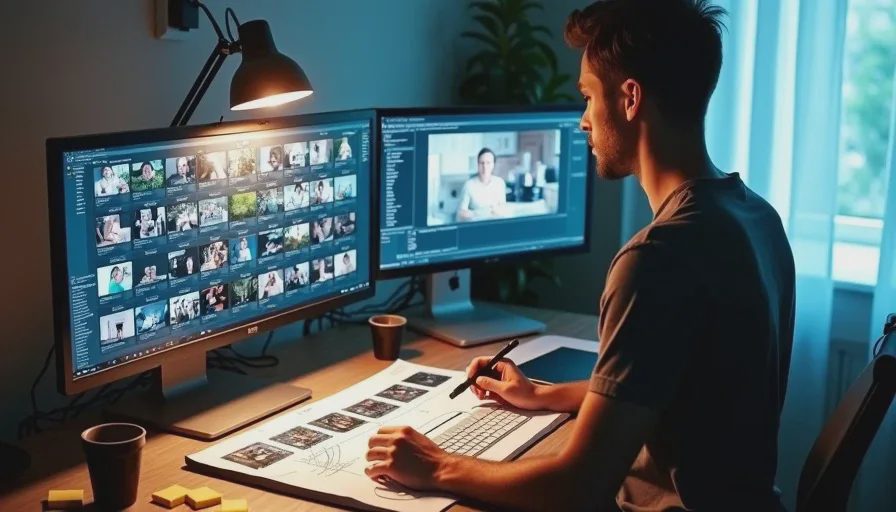
If I were describing the AI-era editor's job to someone trained in traditional post, I'd say it's this.
You decide what the shot is for. Before generation, before the prompt, before the model is chosen — you decide what this shot does. What does it reveal? What does it withhold? What does the audience need to feel when the cut lands? If you can't answer that, the shot isn't ready.
You write the shot list. The shot list is the editorial document. It specifies size, movement, duration, and intent. It's the plan the generation follows. Every decision you'd make in the edit — this shot wide, this shot close, this beat long, this beat short — lives here.
You lock the visual rules. The style block, the character sheet, the location plate. These aren't just reference images. They're the continuity decisions that would normally happen in post — the look, the palette, the identity. Locking them before generation is the AI equivalent of grading and continuity in post.
You select. You generate 164 clips. You watch them. You pick 41. That selection — this clip, not that one — is the edit. It's not assembly. It's judgment.
You route. You decide which model generates which shot. This is an editorial decision about how the film looks and moves. A crane shot goes to Luma. A handheld shot goes to Kling. A camera-driven shot goes to Runway. Each routing decision is a craft decision.
You assemble. You cut the selected clips in sequence. This is the part that looks like traditional editing. It's also the part that's mostly determined by the plan.
You repair. When a shot is 90% right and 10% wrong, you decide whether to fix it or re-roll. That decision is editorial. It's about whether the shot is worth saving.
You grade. You match the generated clips to a consistent world. Color temperature, continuity, palette. The grading is real work, but it's correction, not discovery.
The Frankenstein Shot and the Stitching Continuity
The clearest evidence that editing has moved upstream is the "Frankenstein shot" — the composite that's assembled from the strongest seconds of multiple generations.
More than 40% of final shots in documented AI productions were stitched from two or more generations. A shot might use the first 2 seconds of generation one and the last 2 seconds of generation three. The cut point is hidden under a camera move. The result is a single shot that no single generation produced.
This is editorial work. It's the same logic as cutting between takes in traditional editing — you use the best part of each. But in AI production, the "takes" are generated clips, and the stitching happens at the shot level, not the sequence level.
That's the shift in miniature. In traditional editing, you assemble a scene from takes. In AI editing, you assemble a shot from generations. The editor's work has moved inside the shot.
What Doesn't Change
I want to be careful here, because the "AI changes everything" framing is easy and mostly wrong.
Taste doesn't change. Knowing which shot is right is still the editor's job. AI generates options. It doesn't know which one belongs.
Rhythm doesn't change. The feel of a cut — when to hold, when to move, when to let the audience sit — is still a human sense. AI can generate the shot, but it can't decide how long the shot should live on screen.
Story doesn't change. A film is still a sequence of beats that carry an audience from one emotional state to another. AI can generate the images. It can't decide what the story needs.
Judgment doesn't change. The editor's core skill — knowing what the film needs and recognizing when it's there — is exactly the same. The tools have changed. The craft hasn't.
What changes is when and where that judgment is applied. That's it.
The Cost of Moving Editing Upstream
The shift has real costs, and they're worth naming.
You have to know the film before you make it. Traditional editors discover the film in the edit. AI editors have to know what the film is before they generate a frame. That's harder. It requires a clearer plan, a stronger vision, and a more specific sense of what each shot is for.
You have to commit earlier. In traditional production, you can shoot coverage and decide in post. In AI production, every decision is made at the prompt. If you don't know what the shot is for, you can't generate it. The flexibility of post-production has moved to the rigidity of pre-production.
You have to plan for overgeneration. The documented selection rate is 25% — 164 clips generated, 41 used. That's not waste, it's editorial choice. But it means you're generating four times what you'll ship. You have to budget for it.
You have to repair more. Because you can't discover in the edit, you have to fix in the generation. A shot that's 90% right and 10% wrong is a decision. You fix it or you re-roll. There's no "we'll fix it in post" — the post is where you decide whether to fix it.
What This Means for Editors
If you're an editor trained in traditional post, the shift is not a threat. It's a translation. The skills you have are the skills this workflow needs. They're just applied at a different stage.
The skill you already have: You know how to watch footage and feel what it needs. That skill is the core of AI editing. You watch 164 clips and feel which 41 are right.
The skill you need to add: You need to know the film before the footage exists. You need to be able to write the shot list, lock the style, and decide what each shot is for. That's the translation — applying the same judgment to a plan instead of a timeline.
The skill you don't need to lose: Your taste. Your sense of rhythm. Your ability to know when a shot belongs and when it doesn't. Those are the editor's craft, and AI doesn't have them.
The editor's job in AI production is not assembly. It's decision. It's the same job it's always been. It just happens earlier.
The Deeper Point
Here's the thing that makes this an essay in the "Human in the Loop" category rather than a workflow guide. The shift isn't really about tools. It's about a philosophical assumption that the edit is where the film is found.
In traditional production, that assumption is true. The edit is where the film becomes itself because the footage is raw material. The film is latent in the footage and discovered in the edit.
In AI production, the film is latent in the plan. It's discovered in the shot list, the character sheet, and the selection. The edit is where the plan is realized, not where the film is found.
This is not a loss. It's a different kind of authorship. The editor who knows what they're making — who can decide, before the footage exists, what the film will be — is not replacing the traditional editor. They're a different kind of editor. The craft is the same. The timing is different.
A good shot is not just generated. It is chosen. And the choice is made at the prompt, not the timeline.
Frequently Asked Questions
Does AI replace editors?
No. AI changes where editing begins. The editor's core skill — judgment about what the film needs and recognition of when it's there — is unchanged. What changes is when that judgment is applied. In traditional production, the editor's work happens after the footage exists. In AI production, it happens before — in the shot list, the character sheet, the style block, and the selection.
How has AI changed the editing workflow?
AI has moved the edit upstream. Traditional editing is discovery — finding the film in the footage. AI editing is decision — determining the film before the footage exists. The shot list replaces the timeline. The prompt replaces the take. The selection replaces the assembly. The editor's job is now to decide, not just to cut.
What is a "Frankenstein shot" in AI video editing?
A Frankenstein shot is a shot assembled from the strongest seconds of multiple generations. More than 40% of final shots in documented AI productions were stitched from two or more generations — using the first 2 seconds of one generation and the last 2 seconds of another, with the cut hidden under a camera move. This is editorial work: the same logic as cutting between takes, applied inside the shot.
Why does AI video require overgeneration?
Because selection is the edit. The documented selection rate is 25% — 164 clips generated, 41 used. You generate four times what you ship because the editorial choice happens at selection. Overgeneration is a budget line, not waste. Without it, you have no options, which means no editorial judgment.
Can AI video editors work without traditional editing skills?
No. The core editing skills — knowing what a shot is for, feeling the rhythm of a cut, recognizing when a sequence works — are exactly what AI production needs. The difference is that those skills are applied at the plan stage instead of the timeline stage. An editor who can't articulate what a shot does can't write the shot list that generates it.
What is the biggest challenge of AI video editing?
Knowing the film before you make it. In traditional editing, you can shoot coverage and discover the film in post. In AI production, you have to decide what the film is before you generate a frame. That requires a clearer plan, a stronger vision, and a more specific sense of what each shot is for. The flexibility of post-production has moved to the rigidity of pre-production.
How much does AI video editing cost?
Tool costs depend on the model and the project. Documented AI productions range from $315–$750 per finished minute, with video generation credits making up 70–85% of the spend. But the real cost is overgeneration. A 3-minute episode generated 164 clips and used 41 — a 25% selection rate. Budget for 3–4x your finished runtime in generation.
Will AI ever replace the editor's judgment?
No. AI can generate options. It can't know which one belongs. The judgment — this shot, in this order, for this reason — is the editor's craft. AI can produce a beautiful clip. It can't decide whether the clip serves the film. That decision is still human.