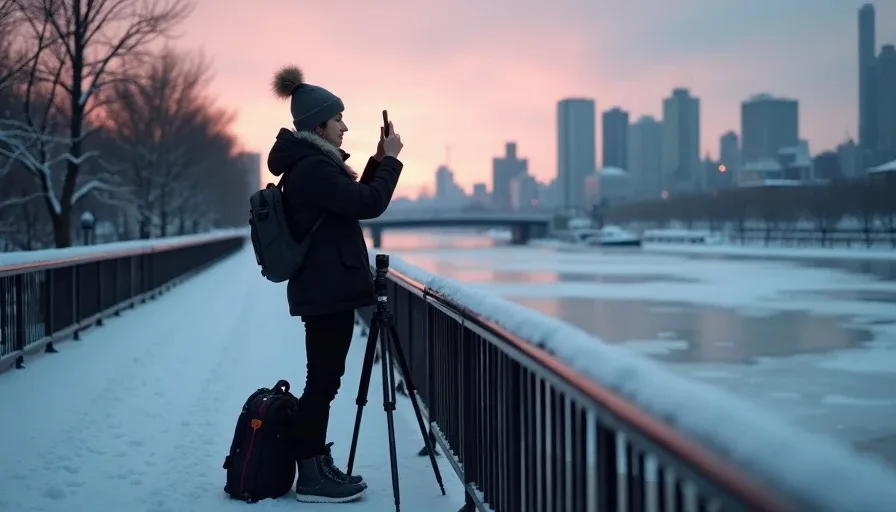
Last winter I generated an establishing shot of Minneapolis at dusk. Wide, elevated, a slow drift across the skyline with the river catching the last light. It was, by any technical measure, a good shot. The buildings had weight. The light was right. The clouds moved at a believable pace.
Then I cut it against the footage that followed — a character walking into a small brick building on a side street — and the whole thing fell apart.
The skyline wasn't my skyline. The river was in the wrong place. The light was beautiful but it wasn't that light — the flat, pinkish-gray dusk you actually get here in January, the one that makes the snow look like concrete. The audience wouldn't have been able to name what was wrong. They would have just felt that the film wasn't set anywhere in particular.
I deleted the shot, drove four blocks, and filmed the real thing on my phone in about ninety seconds. The difference was immediate. The film suddenly had a place.
That's the argument I want to make here, and it's not an anti-AI argument. It's a craft argument. The establishing shot is the one shot where AI's weaknesses are most exposed and its strengths matter least. And it's the one shot where shooting for real costs you almost nothing.
What an Establishing Shot Actually Does
Most discussions of establishing shots treat them as visual throat-clearing — a wide shot to set the scene before the "real" film starts. That's a misunderstanding of the form.
An establishing shot does four things at once, and it does them in the first five seconds of a scene:
It establishes geography. Where are we in relation to everything else? What's the spatial logic of the world the scene takes place in? This is the function everyone knows.
It establishes time and season. Not just "night" — the specific quality of light at a specific hour in a specific month. A real dusk in Minnesota in January does not look like a real dusk in Los Angeles in January. That difference is information.
It establishes scale and relationship. How big is the character's world? Is the building small against a large city, or is it the only thing on the street? This relationship carries meaning. A character in a vast skyline reads differently than a character in a quiet neighborhood.
It establishes tone. A handheld shot of a street reads as documentary. A locked-off shot reads as formal. A drone shot reads as epic or omniscient. The camera's relationship to the location tells the audience how to feel about what follows.
An AI-generated establishing shot can nail the fourth one — tone — better than almost anything else. It's very good at producing a shot that feels like a mood. The problem is that it can't reliably deliver the first three, and the first three are what actually make the shot function as an establishing shot rather than a pretty clip.
Why AI Establishing Shots Fail
I want to be specific about the failure modes, because "AI looks fake" is not a useful criticism and it's not even true anymore. The failure isn't visual quality. It's specificity.
The Geography Problem
AI video generators have no world model. They have a statistical understanding of what "city at dusk" looks like. They do not have a map.
This means every AI-generated establishing shot is a composite of every establishing shot the model has ever seen. The buildings are generic buildings. The streets are generic streets. The relationship between the hill and the river is whatever the model's training data averaged out to.
If your film is set in a real place, this is a problem. Not because the audience will recognize the discrepancy — most won't — but because the film loses its footing. The scene that follows has to work harder to establish where it is, because the establishing shot didn't actually establish anything.
The Light Problem
AI light is beautiful. That's part of the problem.
Real light is specific and often unflattering. The overcast light in Minneapolis in February is flat, slightly blue, and makes everything look a little sad. The golden hour in summer is short and almost violently orange. The light in a parking garage at 7pm has a particular fluorescent-green quality that no one would describe as "cinematic."
AI-generated light tends toward a beautiful average. It's warm where it should be, cool where it should be, and generally flattering. Which means it doesn't tell you anything about where you are or what time it is. It just looks nice.
The Continuity Problem
This is the one that actually breaks films.
If the establishing shot shows a street with buildings on the left and a park on the right, the scene that follows needs to be consistent with that geography. In a real production, that's not a problem — the location is fixed, and the shots inherit its logic automatically.
With AI, the establishing shot is one generation and the shots that follow are different generations. There is no shared world between them. The geography of the establishing shot has no relationship to the geography of any other shot in the film.
I've watched AI shorts where the establishing shot shows a house with a red door and the interior scene shows a character walking through a blue one. Most audiences won't consciously notice. But they'll feel that the film doesn't hold together in a way they can't articulate.
This is the exact problem the researchers called the Deployability Gap — AI video is deliverable only when a practitioner judges which shots the technology can survive and builds the workflow around them. The establishing shot is usually a shot the technology cannot survive, because it's the shot that has to be true for everything else to be believable.
The Argument for Shooting It

Here's the part where the economics get interesting.
The reason AI video is appealing to solo creators is time and money. A camera crew, a location permit, a lighting package — that's the expensive part of production. But an establishing shot doesn't require any of that.
An establishing shot requires a camera and a location. That's it. No actors. No dialogue. No continuity with performances. No blocking. No coverage. You drive to the place, you film the place, you leave.
The shot I deleted and replaced took ninety seconds to film. It was on my phone. It was at dusk, which meant the light was already there and I didn't have to create it. The only cost was the four-block drive and the ninety seconds.
Compared to the cost of generating, re-generating, and trying to save a shot that doesn't actually establish anything — the real shot is cheaper.
And it's not just cheaper. It's better, in ways that compound across the whole film.
It anchors the geography. Every subsequent shot now has a referent. When I cut to the character walking into a building, the audience has a real map in their head. The film has a place.
It anchors the light. The establishing shot's light becomes the reference grade for every shot that follows. I can match the generated footage to the real footage, rather than matching generated footage to other generated footage that has no ground truth.
It gives the film a fingerprint. This is the part that's hard to quantify. A real establishing shot has imperfections — a parked car that doesn't belong, a streetlight that flickers, a person walking through the corner of the frame. Those imperfections are what make a film feel like it's about a real place. They're the opposite of generic.
What I Actually Shoot
I've built a small habit around this. Every time I'm working on a project that needs an establishing shot, I shoot the real one before I generate anything else. It takes an afternoon at most, and it changes the entire production.
What I shoot:
Exteriors of the real locations. Wide, static, on a tripod or a stable surface. Let the location be the location.
Multiple times of day if the schedule allows. Dusk, night, morning. This gives me options in the edit and doubles as reference for the light quality of generated shots.
Establishing shots that include the geography of the scene. If the character enters from the left, the establishing shot should show what's on the left.
A few "texture" shots — a street sign, a reflection in a window, a close-up of the ground. These are the shots that sell the reality of the world, and they cost nothing to film.
What I don't worry about:
Camera quality. My phone is fine. For an establishing shot, the light and the location matter far more than the sensor.
Perfect exposure. I can grade it in Resolve. What I can't fix is a location that isn't real.
Weather. Overcast is not a problem. It's a look. The flat, gray light of a Minnesota winter is a feature, not a bug.
How I integrate it:
The real footage becomes the anchor of the timeline. I grade the AI-generated shots toward it, not the other way around. This is a small workflow change with a large effect. Instead of trying to make a pile of generated clips agree with each other, I'm matching everything to a single reference that has actual light in it.
When AI Establishing Shots Work
I don't want to overstate this. There are cases where an AI-generated establishing shot is the right call, and I use them.
When the place is fictional. If the film is set in a world that doesn't exist — a sci-fi city, a fantasy landscape, a period setting — there is no real version to shoot. AI is the only option, and it's a good one. The geography problem disappears because there's no ground truth to be inconsistent with.
When the establishing shot is abstract. A shot of clouds, a shot of water, a shot of light moving across a surface. These don't establish a specific place, they establish a mood. AI handles mood extremely well. If the shot is doing tone rather than geography, generate it.
When the real location is inaccessible. If the film is set somewhere you can't get to, AI is a legitimate solution. But be aware of the tradeoff — you're losing the fingerprint. The film will feel more generic, and you'll need to compensate elsewhere.
When speed matters more than place. For social content, a generated establishing shot can be fine. The audience isn't tracking geography across a fifteen-second piece. Use the tool that gets you to publish.
The rule I use: if the place is specific and real, shoot it. If the place is generic or fictional, generate it. The mistake is generating a specific real place and then treating the result as if it were the real thing.
The Hybrid Workflow
Here's how the workflow actually runs on a project that combines both.
1. Shot list first. The establishing shot is a line item on the shot list, exactly like every other shot. It has an intent note: "Establishes the neighborhood as quiet and working-class, late afternoon, winter."
2. Shoot the real establishing shots before generating anything. This is the sequencing that matters. The real footage becomes the visual anchor for everything else.
3. Grade the real footage first. Get the establishing shot looking the way you want before you touch the generated clips. This is your reference grade.
4. Generate the AI shots and match them to the real footage. Not the other way around. The real footage is the ground truth.
5. Cut the sequence and check the geography. Does the spatial logic hold? Does the light match? Does the film feel like it's set somewhere?
6. If a generated shot breaks the geography, either re-generate it or cut it. Do not try to save a generated shot that contradicts the real world you established. The contradiction will always win.
The practical effect of this workflow is that the film has a spine. The real shots hold the world together; the generated shots fill in the parts that would be expensive or impossible to film. That's the same division of labor a traditional production uses — practical locations for the world, VFX for the things you can't shoot.
The Part That Isn't About Tools
I want to end on the thing that actually matters here, and it isn't a technical argument.
When I generate an establishing shot, I'm choosing from a set of statistical averages. When I film one, I'm choosing from the actual world. That difference shows up in the final film in ways that are hard to articulate but easy to feel.
The filmmaker's job is not to produce images. It's to make decisions. Every shot in a film is a choice — this location, this angle, this light, this moment. AI can produce an image of a city at dusk. It cannot decide that this city at dusk, on this street, with this light, is the one that belongs in the film.
That decision is the work. The establishing shot is where that work is most visible, because it's the shot that says: this is where we are. If that shot is generated from an average, the film is set in an average. If it's filmed from a real place, the film is set somewhere.
A good shot is not just generated. It is chosen. And the establishing shot is the one where choosing still means going outside.
Frequently Asked Questions
Should I shoot establishing shots practically or generate them with AI?
If the location is real and specific, shoot it. If it's fictional, generic, or abstract, generate it. The establishing shot is the one shot in a film that has to be true — it defines the geography, light, and tone that everything else inherits. A generated establishing shot of a real place produces a composite that doesn't actually establish anything, and the whole film loses its footing.
Why do AI-generated establishing shots look good but feel wrong?
Because AI light tends toward a beautiful average. Real light is specific and often unflattering — flat overcast, harsh fluorescent, that particular pinkish-gray dusk you get in a northern winter. AI-generated light is warm where it should be and cool where it should be, which means it doesn't tell you where you are or what time it is. It looks nice. It doesn't establish anything.
How much does it cost to shoot a real establishing shot?
Almost nothing. An establishing shot requires a camera and a location — no actors, no dialogue, no coverage, no continuity with performances. I've shot usable establishing shots on a phone in ninety seconds. Compared to the cost of generating, re-generating, and trying to save a shot that doesn't establish anything, the real shot is cheaper.